


GILLES CERVARA: HIS 10 TIPS FOR IMPROVING YOUR TENNIS SKILLS
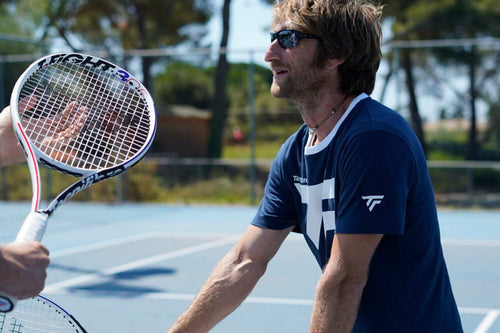


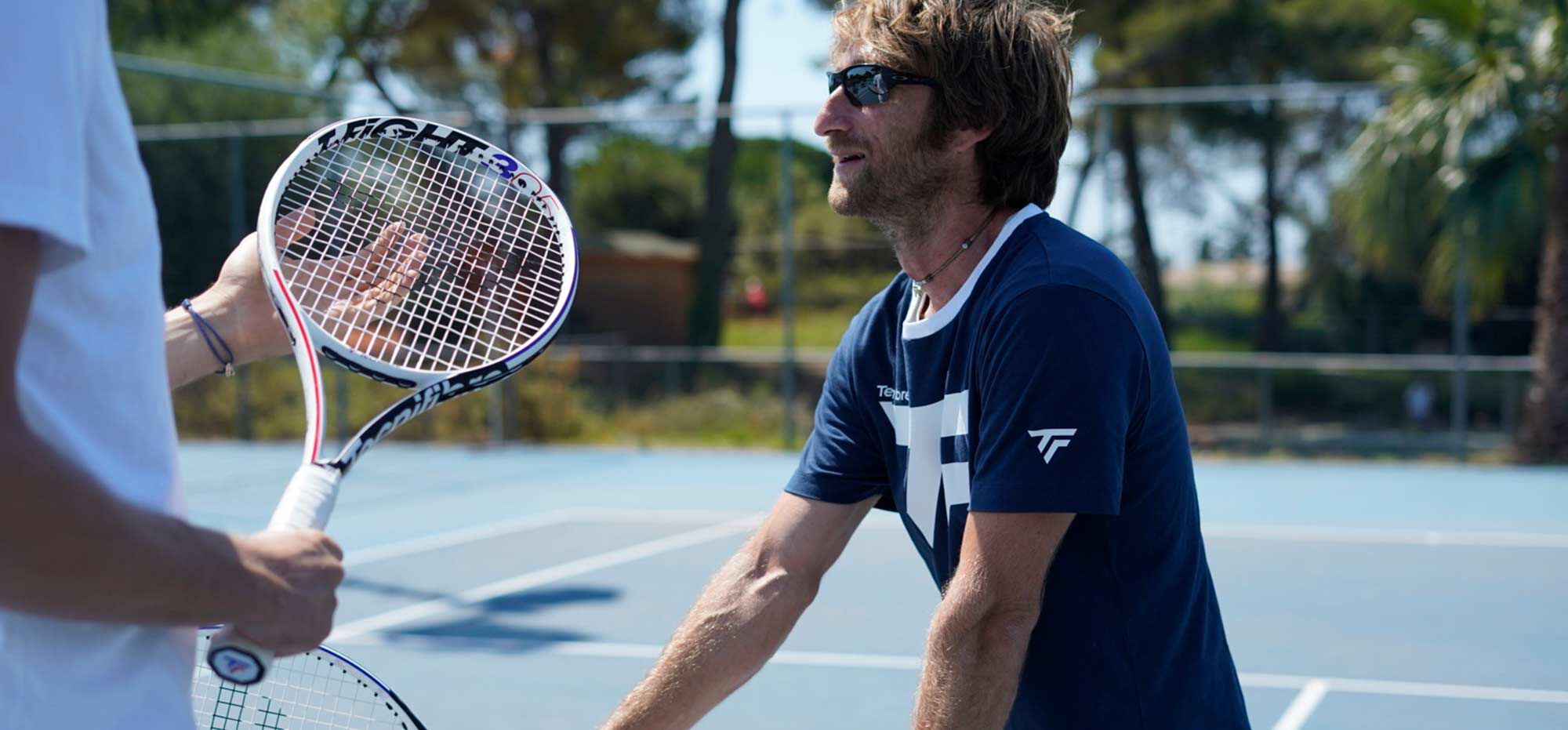
Have you ever dreamed of being coached like a professional player? Well, we asked Gilles Cervara, Daniil's coach and ATP Coach of the Year 2019, to give you some tips to help you achieve your Next Shot!
Missing a shot, losing a match, a set, a game. It happens to all of us and at all levels.
At Tecnifibre, we believe the most important move is always the next one. And we're committed to helping you make it happen!
10 tips from Gilles Cervara to help you.
Next Shot #1: Resuming Competition
To ensure a successful return to competition, I recommend trying to replicate the conditions of a real competition as closely as possible in training.
- Organize training sessions with different partners and with progressive levels.
- Plan times with them in advance and a duration that allows for 2 or 3 sets.
Warm up properly physically before the match. - Do only 5 to 10 minutes of tennis warm-up before starting the match.
- Having the same number of balls on the court as in an official match.
- Bring your own drinks and equipment for the match.
- Prepare and visualize the match mentally beforehand: the playing environment, the club, the opponent…
Next Shot #2: Stop cracking at the slightest direct mistake
To stop falling apart at the slightest direct mistake, I recommend you accept that mistake!
Direct fouls are part of this sport, and they are totally unavoidable.
It should not be a significant event to focus on and disrupt your emotional state.
While it is essential to accept it, it is equally necessary to take it into account in order to understand what caused this mistake and correct it (poor positioning, poor choice of zone, poor shot, bad intention, etc.)
Finding the right balance between accepting the fault and rejecting it is unique to each player.
It can be beneficial to test yourself on this during training to find your balance!
Next Shot #3: Winning a tournament
To win a tournament, I recommend not thinking about this long-term goal, but focusing on another much closer one: the next point.
Focus on the next point, then the one after that, then the one after that, and so on.
Once the first match is won, we can start the same routine again and focus once more on the objective of the next point.
Winning the tournament will simply be a consequence of consistently applying this mentality over time.
With Daniil, we never think about winning a tournament. We stay in the present, but are strongly driven by the energy that comes from our desire and our determination to win.
Next Shot #4: Fight to the end, even when down 6-2, 5-1
To succeed in fighting to the end, even when significantly behind on the scoreboard, I see 3 potential solutions, which depend on each player.
You can try using an inspiring role model to regain your strength.
Think of a very combative player that you particularly appreciate, and draw inspiration from him, keep in mind his image, what he exudes in combat despite the difficulties and his way of fighting to come back.
The second option is to completely detach yourself from the score and focus on the next play as if it were the first of the match.
Finally, another option is to fully connect with the present moment and set a new, immediate, and achievable main goal to maintain motivation: for example, returning to 5/2. Then 5/3. 5/4…
Break down the objectives to avoid thinking about the entire path to take to turn the game around, which would be mentally destructive.
NextShot #5: Make (many) fewer unforced errors
To make (many) fewer unforced errors, I recommend first thinking about the source of the problem. Try to identify with your coach where these unforced errors are coming from.
Is it a problem with a shot that isn't technically controlled? A poor choice of area/spin? A concentration problem? An emotional overload?
My experience in tennis allows me to identify that unforced errors often occur between the 1st and 4th ball strikes, on seemingly innocuous shots.
So you can try to focus, in training, on keeping the ball in the court, sticking to simple patterns and without taking big risks, on those first 4 shots.
Once the point is well initiated, concentration increases more naturally and the frequency of unforced errors decreases.

NextShot #6: Daring to play my game in the heat of the moment
To dare to play your game in crucial moments, I recommend first identifying the crucial moments you want to capitalize on (break points, game points, end of set, end of match) as well as the style of play you want to adopt in those moments (aggressive, defensive, specific game plan, etc.).
Next, to achieve this, it will be necessary to put this objective into practice regularly in training.
Another interesting point is self-assessment: after each hot moment identified, take the time to see if you have succeeded in fulfilling your objective or not, and if this has proven positive on the result.
NextShot #7: Improve one of my shots technically
To improve one of your shots technically, I recommend first consulting your coach. Once you've identified together which shot(s) you want to change, and the reasons why you want to make that change.
We can then proceed through different stages:
- Have a visual of the current move and a model of the future move you want to achieve (clearly identify where you are starting from and where you want to end up).
- Apply the changes to your training by filming yourself to see the progress and discuss it with your coach.
- Work in parallel on visualizing the movement so that it integrates more easily.
Next shot #8: Becoming a physical machine
To (re)become a physical machine, I recommend turning to a physical trainer if you can.
If that's not possible, keep in mind the importance of working on two aspects:
- The muscular aspect to avoid injuries – ideally 2 sessions per week.
- The cardio aspect to manage the repetition of efforts and the increase in intensity – ideally 2 sessions per week as well.
It is very important to be consistent in working on these two aspects in order to feel all the benefits of the work done.
Next shot #9: Reaching a new ranking
To reach a new ranking, I recommend that you first turn to your coach.
Identify with him what new ranking you want to achieve, and use this goal as a target to boost your motivation.
You can make things more concrete by listing, for example, all the things that need to be improved to achieve this ranking. All these specific and concrete objectives help maintain stable motivation over time to reach a longer-term goal, such as this new ranking.
And don't hesitate to reassess things if the final objective turns out to be too important or, on the contrary, too "simple"!
Next Shot #10: Stop blaming my racket when I hit off-center.
To stop blaming your racket when you miss a shot, I recommend you accept that mistake!
Fouls are part of this sport, and they are totally unavoidable.
It should not be a significant event to focus on and disrupt your emotional state.
While it is essential to accept it, it is equally necessary to take it into account in order to understand what caused this mistake and correct it (poor positioning, poor choice of zone, poor shot, bad intention, etc.)
Finding the right balance between accepting the fault and rejecting it is unique to each player.
It can be beneficial to test yourself on this during training to find your balance!
Discover
Read also

Your Child and Tennis - How to Choose the Right Racket for Your Child?

DISCOVER THE STORY BEHIND TECNIFIBRE'S ENVIRONMENTAL LABELLING


